DIY Bicycle Assembly
What Could Go Wrong?

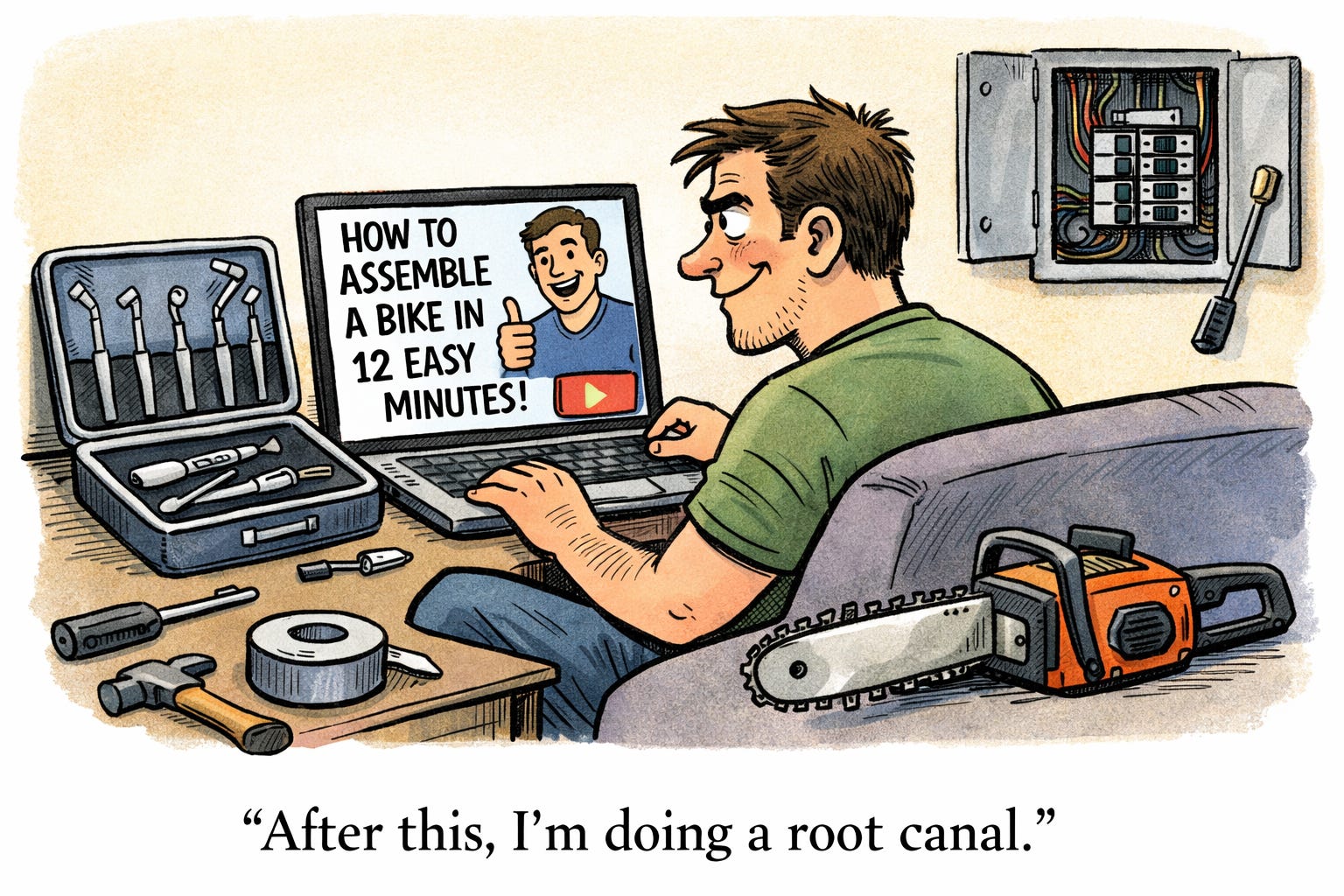
There’s a powerful surge of confidence that comes from watching a three-minute YouTube tutorial, a confidence that makes men believe they can do anything themselves, including light dentistry. So naturally, I recently bought a bicycle online and decided to assemble it myself.
Now I know what you’re thinking: “But Stiffler, if you incorrectly assemble a conveyance capable of traveling at speeds in excess of 40 miles per hour, you could be seriously injured.”
Don’t worry, I knew I wouldn’t get hurt for the following reasons:
I had my very own full set of Allen wrenches.
And, most importantly, the bike would be ridden by my girlfriend.
So, with that safety framework in place, I began the assembly process. I was pleasantly surprised: after only 90 minutes and some moderate frustration, I had finally gotten all the pieces out of the box. Then three hours in, I had something that resembled a bicycle, except for a minor issue with the brakes which are, according to most bicycle experts, an essential safety component—the type of component that prevents the bicycle from continuing indefinitely into a tree, ditch, or (in more advanced cases) a lawsuit.
I just couldn’t get the disk brakes to work. I tried everything: adjusting the calipers, carefully reviewing the instructions I had previously ignored, profanity, and briefly blaming the metric system.
Nothing worked.
It was time to admit defeat and take it into the bike shop—which was my girlfriend Amanda’s position. My position was that it was better to keep torquing Allen wrenches until sunset than admit failure.
Furthermore, I argued that a trained technician would take one look at the brakes, know I assembled it, and quietly judge me as a man.
But Amanda said there was no way the technician could tell just from the brakes. So we made a bet: a round of beers on how quickly the technician would look at the brakes and ask if I had put the bike together myself.
Before the shop though, I prepared to camouflage my incompetence. I memorized some bike phrases so I could be prepared to say things like “The shifting needed some indexing.” or “Maybe I overtorqued the stem bolt beyond spec?” Even though I didn’t know, technically, what spec even means.
I learned this at the hardwood store. Here’s the secret to masquerading as a woodworking expert: they don’t use inches, everything is in quarters. You don’t need a two-inch thick piece of Caribbean Rosewood—you need an eight-quarter piece. Saying inches at a woodworking store immediately blows your cover story.
Detective: “Your wife says you have an alibi, that you, being a woodworker, were in the garage all night. Is that right?”
Suspect: “I was building shelves.”
Detective: “With what?”
Suspect: “Walnut.”
Detective: “Oh yeah? How thick?”
Suspect: “Two inches.”
Detective: “Book him.”
So, with a few of my bike mechanic phrases adequately memorized and practiced—which is a key component, otherwise you’ll sound like my coworker who, trying to connect with my appreciation for sports, will say things like, “It’s important that each of us is like a quarterback rowing toward home plate together,”---Amanda and I wheeled the bike into the shop each waiting to find out who was buying the beer.
Which, in my immediate estimation, was Amanda because within 20 seconds of touching the bike, the technician asked, “Is this a ship-to-home bike you tried to put together yourself?”
“Yes, it is. Wow. You can tell that right away by looking at the brakes?”
“Yep,” the tech said as he clamped the bike into the repair stand, “that and the handlebars are upside down.”
“Well shit.”
I looked at Amanda for backup, but she said nothing.
She was too busy laughing.
I was embarrassed. But I’ll have you know it did take the technician 30 minutes to figure out those brakes, which I had been working on for three hours, so we were basically tied.
I still felt fairly accomplished, however, having successfully assembled all the other bicycle parts, which, from a technical standpoint, is most of the bicycle. And I was further validated when Amanda was able to ride her new bike six miles to a local Colorado microbrewery, where we ordered beers and called it a win.
Over that IPA, I was reminded of one of the great advantages of writing humor: embarrassing moments don’t stay embarrassing; they eventually become jokes. The downside is that you start to view frustrating moments as opportunities for material… which means, at some level, you are now quietly rooting for things to go wrong.
On the way back, Amanda’s left pedal fell off.
Luckily, we were only a half a mile from home, so she would have been able to stand on the right pedal and scooter the rest of the short way.
But the right pedal had fallen off a mile earlier.
Now I’ll admit, as a boyfriend, I was concerned. But as a humor writer, I was thinking, this is fantastic. And although Amanda did have a look like “I’ll punch that smile off your face,” I wasn’t worried. I had seen a YouTube video for that repair.